|
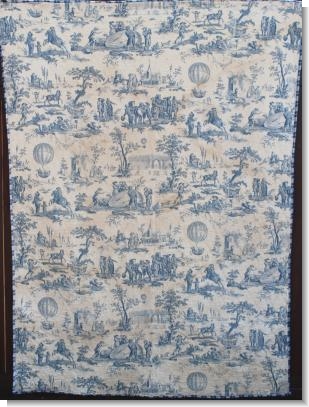
| TOILE de JOUY BALLON PRINT QUILT, c 1785 & later |
£1500 |
Important Toile de Jouy Balloning Quilt.
This print commemorates the flight and landing, on August 27, 1783, of the first hydrogen balloon. Launched in France by Jacques-Alexandre-César Charles, the device carried no passengers and traveled ten miles from the Champs de Mars, in Paris, to the village of Gonesse. There, the peasants, thinking it a monster, attacked it and dragged it across the countryside. Soon afterwards, a proclamation was issued, explaining that a balloon: "so far from being a terrifying phenomenon, it is only a machine…which is quite harmless and which, it is to be presumed, will some day prove of benefit to science."
The invention of the balloon struck the men and women of the late 18th century like a thunderbolt. Enormous crowds gathered in Paris to watch one balloon after another rise above the city rooftops, carrying the first human beings into the air in the closing months of 1783.The excitement quickly spread to other European cities where the first generation of aeronauts demonstrated the wonder of flight. Everywhere the reaction was the same. In an age when men and women could fly, what other wonders might they achieve.
"Among all our circle of friends," one observer noted, "at all our meals, in the antechambers of our lovely women, as in the academic schools, all one hears is talk of experiments, atmospheric air, inflammable gas, flying cars, journeys in the sky." Single sheet prints illustrating the great events and personalities in the early history of ballooning were produced and sold across Europe. The balloon sparked new fashion trends and inspired new fads and products. Hair and clothing styles, jewelry, snuffboxes, wallpaper, chandeliers, bird cages, fans, clocks, chairs, armoires, hats, and other items, were designed with balloon motifs.
A wave of excitement swept across Paris as the gaily decorated balloons rose, one after another, over the skyline of the city. Throughout the summer and fall of 1783 the crowds gathering to witness the ascents grew ever larger. As many as 400,000 people - literally half of the population of Paris -- gathered in the narrow streets around the Château des Tuileries to watch Charles and Robert disappear into the heavens.
Balloon prints produced by 18th and 19th century artists remain as a priceless window into the past. They enable us to share some sense of the excitement that gripped those watching their fellow beings rise into the sky for the first time.
The Americans who were living in Paris to negotiate a successful conclusion to the American revolution were especially fascinated by the balloons. It seemed only fitting that, at a time when their countrymen were launching a new nation, human beings were throwing off the tyranny of gravity. The oldest and youngest members of the diplomatic community were the most seriously infected with "balloonamania."
"All conversation here at present turns upon the Balloons…and the means of managing them so as to give Men the Advantage of Flying," Benjamin Franklin informed an English friend, Richard Price. Baron Grimm, another Franklin acquaintance, concurred. "Among all our circle of friends," he wrote, "at all our meals, in the antechambers of our lovely women, as in the academic schools, all one hears is talk of experiments, atmospheric air, inflammable gas, flying cars, journeys in the sky."
Franklin noted that small balloons, made of scraped animal membranes, were sold "everyday in every quarter." He was invited to visit a friend's home for "tea and balloons," and attended a fête at which the duc de Chartres distributed "little phaloid balloonlets" to his guests. At another memorable entertainment staged by the duc de Crillon, Franklin witnessed the launch of a hydrogen balloon some five feet in diameter that kept a lantern aloft for over eleven hours.
The senior American diplomat in Paris purchased one of the small balloons as a present for his grandson and secretary, William Temple Franklin. Released in a bed chamber, "it went up to the ceiling and remained rolling around there for some time." Franklin emptied the membrane of hydrogen and forwarded it to Richard Price so that he and Sir Joseph Banks might repeat the experiment. The delightful little toy was thus not only the first balloon to be owned by an American but also the first to reach England. Both Franklins were soon supplying little balloons to friends across Europe.
Sixteen year old John Quincy Adams also took note of the small balloons offered for sale by street vendors. "The flying globes are still very much in vogue," he wrote on September 22. "They have advertised a small one of eight inches in diameter at 6 livres apiece without air [hydrogen] and 8 livres with it. .. Several accidents have happened to persons who have attempted to make inflammable air, which is a dangerous operation, so that the government has prohibited them." |
|
|
| |
|

|







 Website By: Red Dragon I.T. Ltd